

J.B. Priestley’s powerful play examines social responsibility through memorable dialogue. The quotes An Inspector Calls presents reveal each character’s moral stance and transformation throughout the story.
This dramatic work uses quotations to expose class divisions and ethical failures in Edwardian society.
Understanding the Key Themes Through Dialogue
The quotes An Inspector Calls offers serve as windows into characters’ souls. Each line reveals attitudes about responsibility, class, and morality that drive the narrative forward.
Mr Birling’s Quotes: Capitalist Arrogance
Arthur Birling represents outdated capitalist values. His quotes An Inspector Calls displays show his ignorance and self-interest clearly.
Business Over Humanity
“I’m talking as a hard-headed, practical man of business… there isn’t a chance of war” demonstrates his foolish confidence. He prioritizes profit above people’s welfare consistently.
“It’s my duty to keep labour costs down” reveals his exploitation of workers. He sees employees as expenses rather than human beings.
“She’d had a lot to say – far too much – so she had to go” shows his authoritarian nature. Eva Smith’s dismissal resulted from standing up for workers’ rights.
Social Climbing
- “You’re just the kind of son-in-law I always wanted”
- “there’s a fair chance that I might find my way into the next Honour’s list”
- “How do you get on with our Chief Constable, Colonel Roberts?”
These quotes An Inspector Calls includes expose Birling’s obsession with social status and connections.
Ironic Predictions
“unsinkable, absolutely unsinkable” refers to the Titanic. This dramatic irony undermines his credibility completely as audiences know the ship sank.
Rejecting Responsibility
“a man has to make his own way – has to look after himself… community and all that nonsense” contradicts the play’s central message. The Inspector arrives immediately after this statement.
“I can’t accept any responsibility” and “Probably a Socialist or some sort of crank” show his refusal to acknowledge guilt or alternative viewpoints.
Mrs Birling’s Quotes: Cold Prejudice
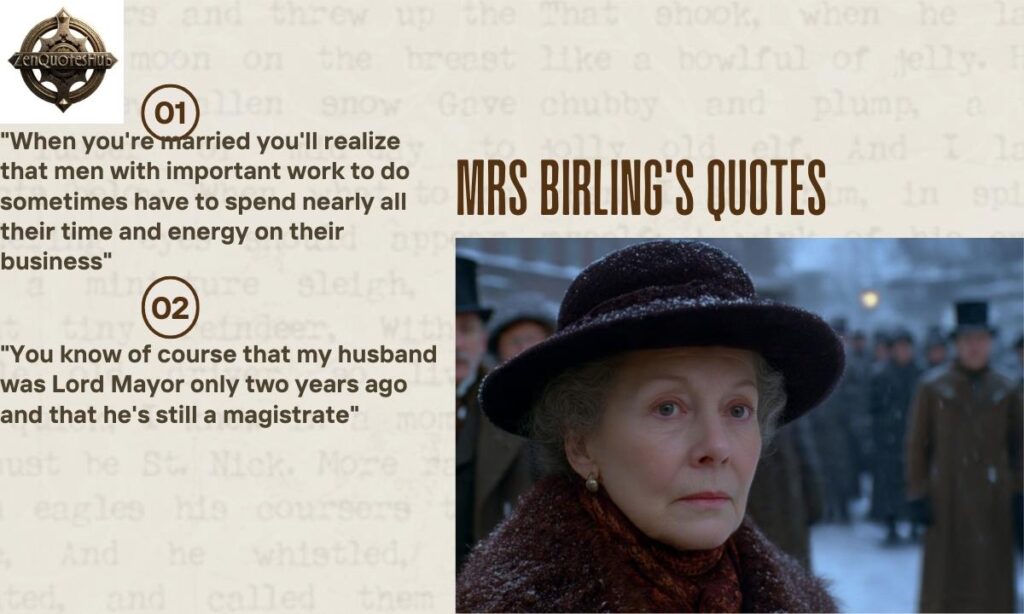
Sybil Birling embodies upper-class cruelty. The quotes An Inspector Calls attributes to her reveal shocking callousness.
Class Superiority
“When you’re married you’ll realize that men with important work to do sometimes have to spend nearly all their time and energy on their business” excuses neglect through class privilege.
“You know of course that my husband was Lord Mayor only two years ago and that he’s still a magistrate” uses status as intimidation.
Blaming the Victim
“I’m very sorry. But I think she had only herself to blame” demonstrates victim-blaming mentality perfectly.
“She was claiming elaborate fine feelings and scruples that were simply absurd in a girl in her position” denies working-class people have dignity or emotions.
Refusing Accountability
- “Unlike the other three, I did nothing I’m ashamed of”
- “I accept no blame at all”
- “I was the only one of you who didn’t give in to him”
These quotes An Inspector Calls presents show her stubborn refusal to accept responsibility for Eva’s death.
“Go and look for the father of the child. It’s his responsibility” ironically condemns her own son unknowingly.
Sheila’s Quotes: Genuine Transformation
Sheila Birling undergoes the most significant change. Her quotes An Inspector Calls features demonstrate awakening social conscience.
Initial Happiness to Horror
“I’ve been so happy tonight. Oh I wish you hadn’t told me” shows her initial naivety about consequences.
“I think it was a mean thing to do. Perhaps that spoilt everything for her” begins her journey toward understanding.
Recognition of Humanity
“These girls aren’t cheap labour. They’re people” marks her ideological shift from her father’s views.
“I’ll never, never do it again to anybody… I feel I can never go there again” demonstrates genuine remorse.
Insight and Understanding
“Why – you fool – he knows. Of course he knows” shows she grasps the Inspector’s omniscience before others.
“You and I aren’t the same people who sat down to dinner here” acknowledges permanent transformation.
Challenging Her Parents
“Mother, I think it was cruel and vile” confronts her mother’s heartless decision directly.
“You’re beginning to pretend all over again that nothing much has happened” criticizes their return to complacency.
Accepting Truth
The quotes An Inspector Calls gives Sheila reveal maturity. “Well, he inspected us all right. And let’s not start dodging and pretending now” maintains moral clarity.
“I suppose we’re all nice people now” uses bitter sarcasm to condemn their collective hypocrisy.
Eric’s Quotes: Troubled Conscience
Eric Birling struggles with alcoholism and guilt. His quotes An Inspector Calls contains show vulnerability and anger.
Recognizing Alternatives
“He could have kept her on instead of throwing her out” questions his father’s harsh decision.
Confession
- “I’ve had a few drinks, including rather a lot of champagne”
- “I was in that state when a chap easily gets nasty”
- “I didn’t even remember – that’s the hellish thing”
These quotes An Inspector Calls provides expose his drinking problem and assault of Eva Smith.
Eva’s Dignity
“She didn’t want me to marry her… In a way, she treated me as if I were a kid” shows Eva maintained more maturity than him.
Theft and Desperation
“I got it – from the office… I intended to pay it back” reveals his embezzlement to support Eva.
Confronting His Father
“you’re not the kind of father a chap could go to when he’s in trouble” explains his inability to seek help.
“my child – your own grandchild – you killed them both – damn you, damn you” delivers devastating accusation against his mother.
Maintaining Responsibility
“It’s what happened to the girl and what we all did to her that matters” keeps focus on their collective guilt.
Gerald’s Quotes: Complex Complicity
Gerald Croft occupies middle ground morally. The quotes An Inspector Calls assigns him reveal mixed motivations.
Solidarity with Birling
“I know we’d have done the same thing” shows class loyalty over moral judgment.
“For God’s sake – don’t say anything to the inspector” attempts to protect secrets.
Protecting Sheila
“I think Miss Birling ought to be excused any more of this questioning” demonstrates some gallantry.
The Affair
“We went to the County Hotel, which I knew would be quiet at that time of night” reveals his calculated approach.
“All that she wanted was to talk – a little friendliness” justifies the relationship as kindness.
“I didn’t install here there so that I could make love to her” claims pure intentions unconvincingly.
Limited Feelings
“I didn’t feel about her as she felt about me” admits emotional inequality in their relationship.
“She told me she’d been happier than she’d ever been before” acknowledges he provided temporary relief.
Return to Normal
“Everything’s all right now, Sheila. What about this ring?” shows he learned nothing ultimately.
Inspector Goole’s Quotes: Moral Authority
The Inspector represents conscience and justice. His quotes An Inspector Calls centers around carry the play’s message.
Eva’s Suffering
“Burnt her inside out… she was in great agony” forces them to confront brutal reality.
Interconnected Responsibility
“What happened to her… a chain of events” explains how each person contributed to her death.
Social Justice
“It’s better to ask for the earth than to take it” defends workers’ rights to demand fair treatment.
“There are a lot of young women living that sort of existence in every city and big town in this country” universalizes Eva’s suffering.
Collective Guilt
“We have to share something. If there’s nothing else, we’ll have to share our guilt” emphasizes communal responsibility.
Judging Power
“Public men, Mr Birling, have responsibilities as well as privileges” challenges Birling’s abuse of authority.
“She needed not only money but advice, sympathy, friendliness… you slammed the door in her face” condemns Mrs Birling’s cruelty.
Final Warnings
“each of you helped to kill her. Remember that. Never forget it” assigns equal responsibility to all.
“Croft… he at least had some affection for her and made her happy for a time” acknowledges Gerald’s partial decency.
Prophetic Conclusion
“But just remember this… fire and blood and anguish. Good night” predicts the world wars to come.
Character Quote Comparison
| Character | Main Theme | Attitude Change |
| Mr Birling | Capitalism | None |
| Mrs Birling | Class prejudice | None |
| Sheila | Social conscience | Complete transformation |
| Eric | Guilt and weakness | Partial change |
| Gerald | Self-interest | Minimal change |
| Inspector | Justice | Unchanging moral authority |
FAQs
What do Mr Birling’s quotes reveal about his character?
His quotes show arrogance, capitalist greed, and refusal to accept social responsibility throughout the play.
Why are Sheila’s quotes important?
Sheila’s dialogue demonstrates genuine moral transformation and represents the younger generation’s potential for change in society.
What makes Inspector Goole’s quotes powerful?
His words carry prophetic weight and moral authority that exposes each character’s guilt and challenges their conscience directly.
How do Mrs Birling’s quotes show her prejudice?
Her statements reveal class snobbery, victim-blaming, and cruel dismissal of working-class people’s feelings and dignity.
What do Eric’s quotes tell us about his struggles?
His dialogue exposes alcoholism, desperation, and eventual understanding of collective responsibility despite personal weakness and mistakes.
Why are Gerald’s quotes morally ambiguous?
His words show he provided temporary kindness to Eva but ultimately returns to his privileged position unchanged.
How do the quotes An Inspector Calls uses create dramatic irony?
Birling’s predictions about war and the Titanic contradict known history, undermining his authority completely.
Conclusion
The quotes An Inspector Calls presents remain relevant today. Priestley crafted dialogue that exposes moral failings while offering hope through younger characters’ transformation. Each line serves the play’s central message about collective responsibility.
These powerful words continue challenging audiences to examine their own complicity in social injustice. The quotations reveal how individual actions create chains of consequences affecting vulnerable people. Priestley’s masterful use of dialogue ensures his socialist message resonates across generations effectively.

My name is Wilson, and I specialize in creating inspiring and meaningful quotes. With 4 years of experience in the quotes niche, I craft words that motivate, connect, and leave a lasting impact.