

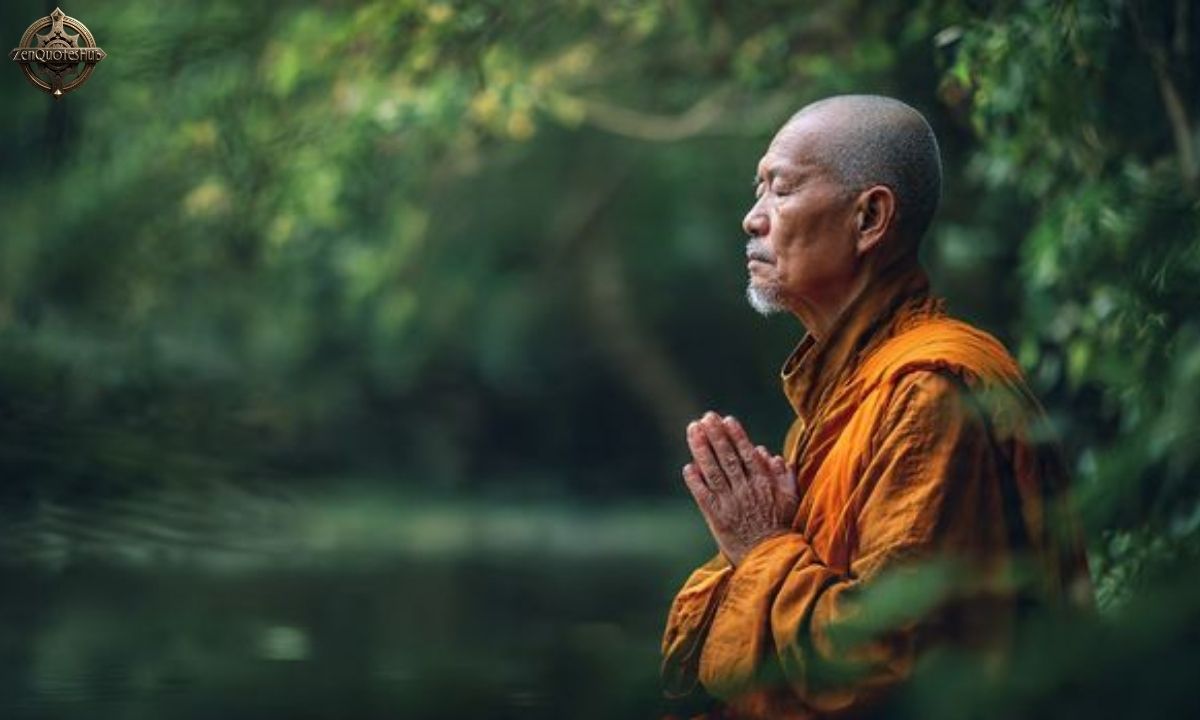
Thích Nhất Hạnh was more than a Buddhist monk. He was a peace activist, Zen teacher, and spiritual guide whose words changed millions of lives. His teachings on mindfulness meditation and conscious breathing help us find calm in chaos.
Through Engaged Buddhism, he showed the world that spirituality belongs in everyday life. His books like The Miracle of Mindfulness and No Mud, No Lotus teach us to embrace pain, practice self-awareness, and discover joy in the present moment. These quotes will inspire your journey toward inner peace.
On Mindfulness and Living in the Moment
Being in the moment is the foundation of mindful living. When we practice awareness, life reveals its hidden miracles.
- Mindfulness is the miracle which can call back in a flash our dispersed mind and restore it to wholeness so that we can live each minute of life.
- The present moment is filled with joy and happiness. If you are attentive, you will see it.
- Walk as if you are kissing the Earth with your feet.
- Breath is the bridge which connects life to consciousness, which unites your body to your thoughts. Whenever your mind becomes scattered, use your breath as the means to take hold of your mind again.
- Life is available only in the present moment.
- We are very good at preparing to live, but not very good at living. We know how to sacrifice ten years for a diploma, and we are willing to work very hard to get a job, a car, a house, and so on. But we have difficulty remembering that we are alive in the present moment.
- You can see everything in the universe in one tangerine. When you peel it and smell it, it’s wonderful. You can take your time eating a tangerine and be very happy.
- I promise myself that I will enjoy every minute of the day that is given me to live.
- If we continue to hold on to a dream for something in the future, we lose the present moment. And if we lose the present, we lose everything.
- Cultivating a strong training in meditation and mindfulness is not an opiate to escape what’s going on but a way for us to truly still the mind and look deeply, in order to see ourselves and the world clearly.
- To think in terms of either pessimism or optimism oversimplifies the truth. The problem is to see reality as it is.
- Anxiety, the illness of our time, comes primarily from our inability to dwell in the present moment.
- The reality is that we are safe and we have the capacity to enjoy the wonders of life in the present moment. When we recognize that our suffering is based on images instead of current reality, then living happily in the present moment becomes possible right away.
- The best way to take care of the future is to take care of the present moment.
- Breathing in, I calm body and mind. Breathing out, I smile. Dwelling in the present moment I know this is the only moment.
- Live the actual moment. Only this actual moment is life.
Daily practice of conscious breathing brings us back to self-awareness. This is how we build a calm mind that stays steady through life’s storms.
On Anger, Fear, and Suffering

Transforming suffering into wisdom is at the heart of Buddhist teachings. Emotional healing begins when we stop running from pain.
- When a person’s speech is full of anger, it is because he or she suffers deeply.
- The main cause of your suffering is the seed of anger in you, because it has been watered too often, by yourself and by other people.
- The fact is that when you make the other suffer, he will try to find relief by making you suffer more. The result is an escalation of suffering on both sides.
- When you begin to see that your enemy is suffering, that is the beginning of insight.
- The seed of suffering in you may be strong, but don’t wait until you have no more suffering before allowing yourself to be happy.
- When anger manifests in us, we must recognize and accept that anger is there and that it needs to be tended to. At this moment we are advised not to say anything, not to do anything out of anger.
- The only way to ease our fear and be truly happy is to acknowledge our fear and look deeply at its source. Instead of trying to escape from our fear, we can invite it up to our awareness and look at it clearly and deeply.
- The source of suffering is a false belief in permanence and the existence of separate selves.
- Some people live as though they are already dead. There are people moving around us who are consumed by their past, terrified of their future, and stuck in their anger and jealousy. They are not alive; they are just walking corpses.
- Sometimes our parents are full of love and sometimes they are full of anger. This love and anger comes not only from them, but from all previous generations. When we can see this, we no longer blame our parents for our suffering.
- Go back and take care of yourself. Your body needs you, your perceptions need you, your feeling needs you. The wounded child in you needs you. Your suffering needs you to acknowledge it.
- It is possible of course to get stuck in the mud of life. It’s easy enough to notice mud all over you at times. The hardest thing to practice is not allowing yourself to be overwhelmed by despair.
- It is possible to listen to suffering in such a way that we don’t get sucked in.
- Life is filled with suffering, but it is also filled with many wonders.
- If we believe that tomorrow will be better, we can bear a hardship today.
- Without suffering, we do not have the opportunity to cultivate compassion and understanding; and without understanding, there can be no true love.
- We ruminate on suffering, regret, and sorrow. We chew on them, swallow them, bring them back up, and eat them again and again.
- We have to learn how to embrace and cradle our own suffering and the suffering of the world, with a lot of tenderness.
- If we’re feeding our suffering while we’re walking, working, eating, or talking, we are making ourselves victims of the ghosts of the past, of the future, or our worries in the present. We’re not living our lives.
- If your house is on fire, the most urgent thing to do is to go back and try to put out the fire, not to run after the person you believe to be the arsonist.
- Don’t make yourself into a battlefield; the world doesn’t need any more fanatics.
- We all have the seeds of both anger and compassion.
Anger management becomes possible through mindfulness of emotions. When we practice self-compassion and acceptance, we stop being our own enemy. Healing the inner child means embracing pain instead of fighting it. This is the path of no mud, no lotus.
On Inner Understanding and Personal Transformation

Personal growth happens when we look inward with honesty. Right understanding comes from direct experience, not borrowed beliefs.
- If you are not able to take care of yourself, if you are not able to accept yourself, how could you accept another person and how could you love him or her?
- Our quality of being determines our quality of doing.
- You have to realize that happiness is not something you find at the end of the road.
- Every day we are engaged in a miracle which we don’t even recognize: a blue sky, white clouds, green leaves, the black, curious eyes of a child—our own two eyes. All is a miracle.
- Aimlessness does not mean doing nothing. It means not putting something in front of you to chase after.
- I come here empty-handed, and I go empty-handed. My actions are my only true belongings. I cannot escape the consequences of my actions. My actions are the ground on which I stand.
- Usually when we hear or read something new, we just compare it to our own ideas. If it is the same, we accept it and say that it is correct. If it is not, we say it is incorrect. In either case, we learn nothing.
- When our beliefs are based on our own direct experience of reality and not on notions offered by others, no one can remove these beliefs from us.
- The truth is the truth, whether or not it is accepted by the majority. Therefore, I tell you children, it takes great courage to stand up for and protect what is right.
- Now I see that if one doesn’t know how to die, one can hardly know how to live—because death is a part of life.
- Life is illuminated by right understanding, right thought, right speech, right action, right livelihood, right effort, right mindfulness, and right concentration.
- For things to reveal themselves to us, we need to be ready to abandon our views about them.
- Guarding knowledge is not a good way to understand. Understanding means to throw away your knowledge.
- You trust that you contain the whole cosmos; you are made of stars. And that is why you respect yourself and offer reverence to yourself. And, when you look at another person, you see that they are also made of stars.
- The Three Kinds of Pride are: (1) thinking I am better than the other(s); (2) thinking I am worse than the other(s); and (3) thinking I am just as good as the other(s).
- You cannot take the mind out of the body, and you cannot take the body out of the mind.
- Letting go gives us freedom, and freedom is the only condition for happiness. If, in our heart, we still cling to anything—anger, anxiety, or possession—we cannot be free.
- Death is essential to making life possible. Death is transformation. Death is continuation. When we die, something else is born, even if it takes time to reveal itself or for us to be able to recognize it.
- In this very moment all of us are dying. Some of us are dying more slowly and some of us more quickly.
- To breathe and know you are alive is wonderful. Because you are alive, everything is possible.
- The way out is in.
Self-acceptance opens the door to spiritual awakening. When we practice letting go and detachment, we discover that transformation isn’t about becoming someone new. It’s about returning to awareness of self. The way out is in means looking inward for answers instead of seeking them outside.
On Love, Compassion, and Peace
True love begins with understanding others and ourselves. Compassion in action means showing up, listening deeply, and offering presence.
- The most effective way to show compassion to another is to listen, rather than talk.
- Compassion is a verb. It requires action and understanding.
- True love is a love without possessiveness.
- The first definition of love is to be there.
- In true love, there is no pride.
- To love is to recognize; to be loved is to be recognized by the other.
- If you love someone but rarely make yourself available to him or her, that is not true love.
- What is love? Love is treating your heart with a great deal of tenderness, with understanding, love, and compassion. If you cannot treat your own heart this way, how can you treat your partner with understanding and love?
- Happiness is a function of compassion. If you do not have compassion in your heart, you do not have any happiness.
- In true love, you attain freedom. When you love, you bring freedom to the person you love.
- Once there is seeing, there must be acting. Otherwise, what’s the use of seeing?
- If we want peace, we have to be peace. Peace is a practice and not a hope.
- Peace is present right here and now, in ourselves and in everything we do and see. Every breath we take, every step we take, can be filled with peace, joy, and serenity.
- You are not an observer, you are a participant.
- If in our daily life we can smile, if we can be peaceful and happy, not only we, but everyone will profit from it. This is the most basic kind of peace work.
- We’re so close to Earth that sometimes we forget how beautiful it is.
- To understand is to love.
Loving kindness starts within. Peace activism isn’t about grand gestures. It’s about engaged mindfulness in daily interactions. When we practice nonviolence in thoughts and words, we create harmony around us. This interconnectedness reminds us that peace in the world begins with peace within.
How to Apply Thích Nhất Hạnh’s Teachings in Daily Life
These spiritual quotes offer more than inspiration. They provide a roadmap for living with intention and awareness.
Start with simple breathing techniques. When stress rises, pause and take three conscious breaths. This brings you back to the present moment.
Practice gratitude for small things. Notice the sky, your morning coffee, the sound of rain. These moments hold serenity if we pay attention.
Work on emotional healing through self-compassion. When anger or fear arises, acknowledge it without judgment. Name the emotion and breathe with it.
Build a daily practice of meditation. Even five minutes of sitting quietly can strengthen your awareness and create a calm mind.
Listen deeply to others. Put away distractions and offer full presence. This is compassion in action, and it transforms relationships.
Remember that awakening isn’t a destination. It’s the continuous choice to return to mindfulness, breath by breath, step by step.
The Legacy of Plum Village and Engaged Buddhism
Plum Village in France became a living example of mindful living. Thích Nhất Hạnh created a community where people practice meditation, work mindfully, and live in harmony.
The Engaged Buddhism movement proved that spirituality and social action aren’t separate. During the Vietnam War, monks and nuns didn’t retreat from suffering. They walked directly into it with compassion and courage.
This approach continues today. Mindfulness retreats, peace activism, and community gatherings around the world carry forward his vision. His teachings on interbeing remind us that we’re all connected.
When one person heals, it ripples outward. When one person practices peace, it touches everyone around them. This is the power of engaged mindfulness.
Frequently Asked Questions
What is mindfulness according to Thích Nhất Hạnh?
Mindfulness is being fully present and aware in each moment without judgment.
How can I practice mindful living every day?
Start with conscious breathing, walk with awareness, and bring full attention to daily activities.
What does No Mud, No Lotus mean?
It means suffering is necessary for growth, just as lotus flowers need mud to bloom.
How do you transform suffering into peace?
By acknowledging pain, breathing with it, and practicing self-compassion instead of resistance.
What is Engaged Buddhism?
A movement combining spiritual practice with social action and compassion for all beings.
How can I develop a calm mind?
Through regular meditation practice, mindful breathing, and returning attention to the present moment.
Conclusion
Thích Nhất Hạnh’s wisdom offers a path through modern chaos. His words on mindfulness meditation, transforming suffering, and finding peace remind us that joy lives in the present moment.
These teachings aren’t abstract philosophy. They’re practical tools for emotional healing, personal growth, and building a life of meaning. Start with one quote, one breath, one mindful step. That’s where transformation begins.

My name is Wilson, and I specialize in creating inspiring and meaningful quotes. With 4 years of experience in the quotes niche, I craft words that motivate, connect, and leave a lasting impact.